Website change monitoring for teams

Turn any web page into trackable data

Paste a URL and say what matters. BriefPanel recognizes the items and their fields, re-reads them on your schedule, and records every change as a structured event — not a screenshot.

Takes you to BriefPanel, where the structure of your page is recognized in seconds. No account needed to start.

20 free checks after email verification · no subscription · R$0.050 per page read

See how it works
  • Identity by item

    Recognize the same product, job, or story on every check.

  • Changes with context

    See the type, importance, and available evidence for each change.

  • You define the signal

    Set a prompt and cadence that match each business decision.

How it works

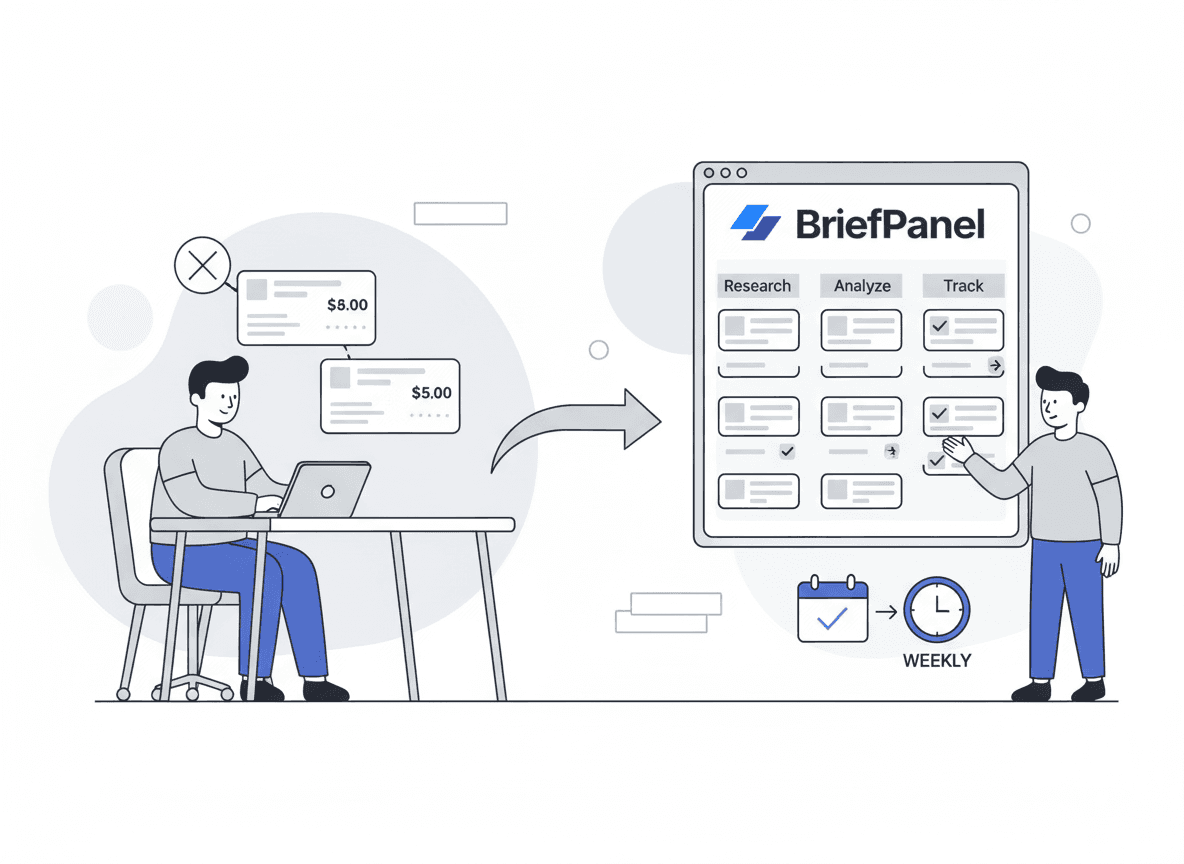
The same four steps you take in the app

From a URL to a monitored source in a few minutes. Each step shows you what BriefPanel understood before asking for anything.

  1. 1/4

    Link and intent

    Choose a source

    Paste the page that lists what matters and describe, in your own words, what you want to track.

  2. 2/4

    Records and fields in seconds

    Recognize the structure

    BriefPanel reads the page and proposes the records and fields it will track. You confirm or correct them.

  3. 3/4

    Cadence and alerts

    Set up watching

    Pick the cadence and the changes worth an alert: new items, removals, price moves, rewritten details.

  4. 4/4

    Keep it and get alerts

    Save access

    Confirm your email to keep the source, get alerts, and read its history in the app or through the API.

A record per item, re-found on every check — not a diff of a page.

What you point it at

Any public page with a list of things that change

Pick a category to see the item, the fields worth watching, and who acts on the change.

Item

A product

Catalog and category pages, with each product followed on its own page.

Fields watched

  • price
  • stock
  • promo
  • variant
  • shipping

Who acts

Pricing & category ops

Decision

Reprice, chase a supplier, or rebalance the assortment the day it moves.

Information, not noise

See which item changed, in which field, and with what impact.

Page diff

The page changed.

BriefPanel

Structured event

Regulatory deadline moved up by 46 days.

Fictional example

Critical suppliers

MODIFIEDCRITICAL IMPACT

Deadline

Sep 30Aug 15

Risk of non-compliance.

Fictional example. Not legal advice.

Continuous history

Follow a policy as a story, not disconnected snapshots

Regulatory content changes in stages. The timeline connects every update to the same item and keeps the context needed to assess impact and next steps.

  • See when the proposal or policy status changes.
  • Compare changes to scope and relevant language.
  • Identify dates, obligations, and deadlines that require action.

Regulatory status over time

  1. May 21, 2024NEW

    Final adoption recorded

    Regulatory statusNot trackedAdopted

  2. Jul 12, 2024MODIFIED

    Text published in the Official Journal

    Regulatory statusAdoptedPublished

  3. Aug 1, 2024MODIFIED

    Regulation entered into force

    Regulatory statusPublishedIn force

Editorial reconstruction based on fictional facts.

For technical teams

Structured changes for systems, automations, and agents

Query item-level history through the REST API or MCP. No reprocessing HTML, screenshots, or page diffs.

A data contract ready to integrate

The same typed feed serves custom integrations and AI agents.

  • Paginated item-level feed

    Read changes across every source by cursor, time, and importance.

  • Before and after by attribute

    Price and custom fields arrive with their type, previous value, and current value.

  • REST and MCP on the same model

    Your system queries the API; agents use get_source_changes without losing context.

RESTGET /v1/updates?importance=material
200 OK
{
  "data": [
    {
      "sourceName": "Acme Cloud (fictional)",
      "entryTitle": "Scale plan",
      "kind": "plan",
      "updateType": "modified",
      "importance": "material",
      "field": "price",
      "valueChange": {
        "type": "number",
        "previous": 49,
        "current": 59,
        "unit": "USD"
      },
      "priceDelta": 10
    },
    {
      "entryTitle": "Payments API",
      "kind": "documentation",
      "updateType": "modified",
      "importance": "critical",
      "field": "authentication",
      "valueChange": {
        "type": "string",
        "previous": "API key",
        "current": "OAuth 2.0"
      }
    }
  ],
  "pagination": {
    "nextCursor": null,
    "hasMore": false
  }
}
The same feed is available through MCP
get_source_changes
Fictional example; the fields and envelope match the public API contract.

Anatomy of a change event

entryTitle
The resolved item — not the page. History attaches here.
updateType
new, modified, or removed. A removal is a signal too.
importance
critical, material, or minor, so you can filter noise server-side.
field
The named attribute that moved, derived from your monitoring prompt.
valueChange
Typed previous and current values, with unit where it applies.

Delivery

Six surfaces, one contract

Push to people, push to systems, or pull on demand. Agents read the same model through MCP.

  • Email

    A digest per source, grouped by item and importance, plus instant alerts for the changes you chose.

    Best for: Analysts and reviewers

  • Push

    A notification on your phone or browser when a material change lands.

    Best for: People on the move

  • Slack

    A message per material change, in the channel that owns the source.

    Best for: Teams that act the same day

  • Discord

    The same message, posted through a channel webhook.

    Best for: Communities and small teams

  • REST API

    A cursor-paginated feed, filterable by time and importance.

    Best for: Warehouses and automations

  • MCP

    get_source_changes returns the same model to an agent.

    Best for: Agentic workflows

Usage-based pricing

Pay for monitored volume. No monthly subscription.

One page read consumes 1 credit. Model your operation's monthly volume.

1 credit = 1 page read. A source whose items have their own pages reads up to pages per check.

Set cadence per source and focus volume where freshness is critical.

Top up credits on demand.

Start with free checks after verifying your email. Self-service purchase, with no contract or recurring plan.

Configure volume

1 when the source's items have no pages of their own, up to 1 when they do.

This estimate uses a 30-day month. Actual usage depends on configured cadences, checks that run, and how many item pages each check follows.

Operational projection

Monthly volume and cost

Checks150
Page reads300
Projected cost/mo

Loading current pricing…

Loading current pricing…
Start monitoring

FAQ

Frequently asked questions

Everything you need to know about BriefPanel.

From the blog

Playbooks for change intelligence

Practical guides to following competitors, pricing, regulation, vendors, and documentation with decision-ready context.

The Competitor Intelligence Stack for Product Managers (Layers, Build-vs-Buy, and Where Monitoring Fits)

Dec 28, 2025

The Competitor Intelligence Stack for Product Managers (Layers, Build-vs-Buy, and Where Monitoring Fits)

How product managers assemble a modern competitive intelligence stack: the signal-collection, analysis, and enablement layers, build-vs-buy trade-offs, and why page monitoring is the foundation. With recent CI research and benchmarks.

Read more
How to Monitor Competitor Pricing and Packaging Changes (Alerts, Templates, and a Repeatable System)

Dec 29, 2025

How to Monitor Competitor Pricing and Packaging Changes (Alerts, Templates, and a Repeatable System)

A practical system to track competitor pricing, tiers, usage limits, and add-ons—plus templates and an automated way to get AI-written change summaries with BriefPanel.

Read more
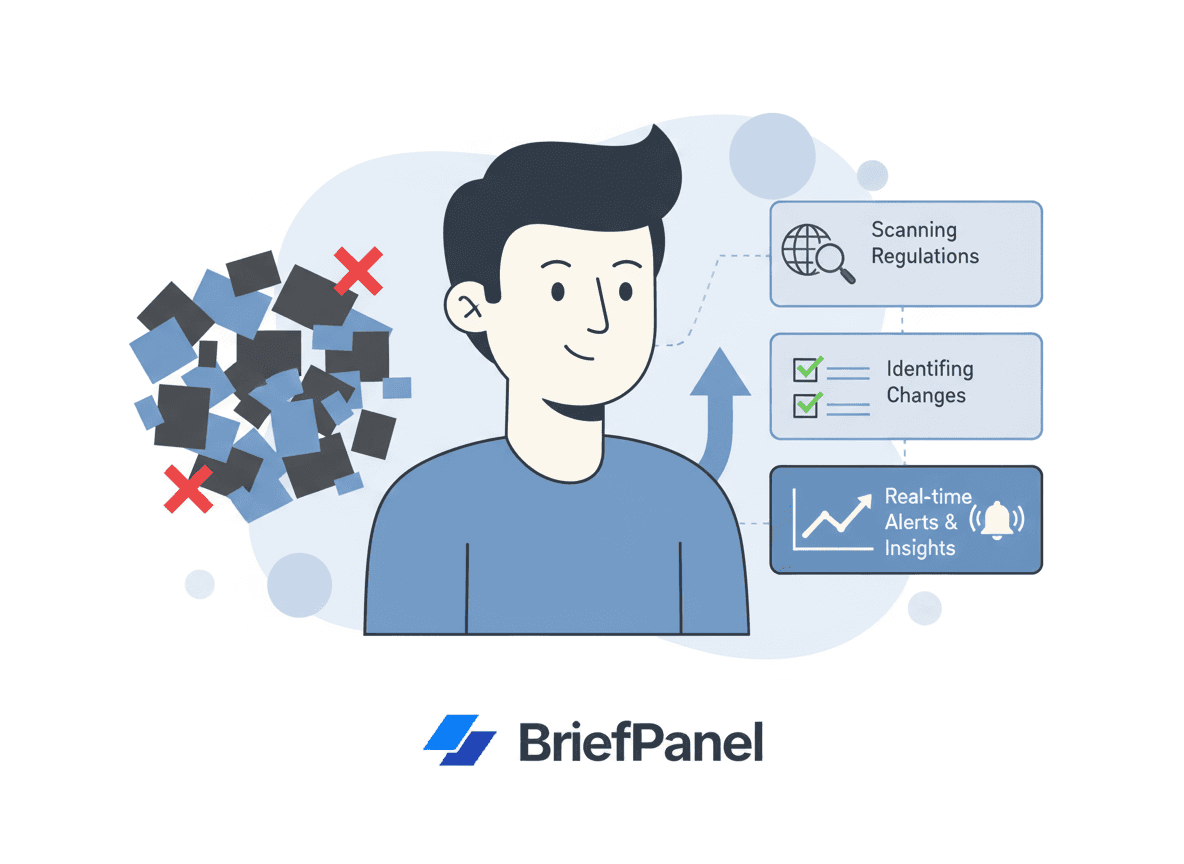
How to Monitor Government Regulation Updates Without Missing Critical Changes

Dec 19, 2025

How to Monitor Government Regulation Updates Without Missing Critical Changes

A practical guide for compliance, legal, and GRC teams: track the Federal Register, EUR-Lex, and agency guidance for new rules, then turn page changes into clear AI briefs with BriefPanel.

Read more
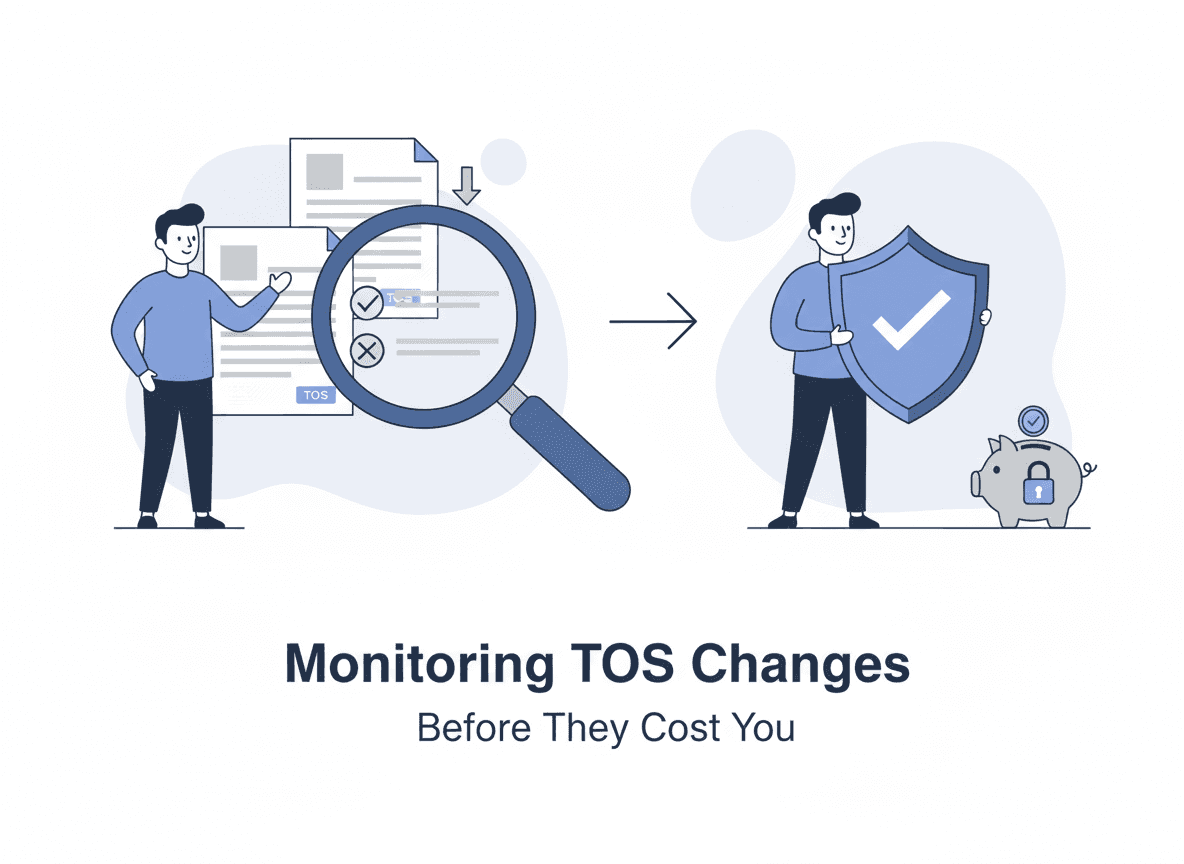
How to Monitor Terms of Service Changes (Before They Cost You)

Dec 16, 2025

How to Monitor Terms of Service Changes (Before They Cost You)

Track Terms of Service, privacy policy, and DPA updates with a practical monitoring framework, recent legal examples, and clear AI summaries of what changed.

Read more
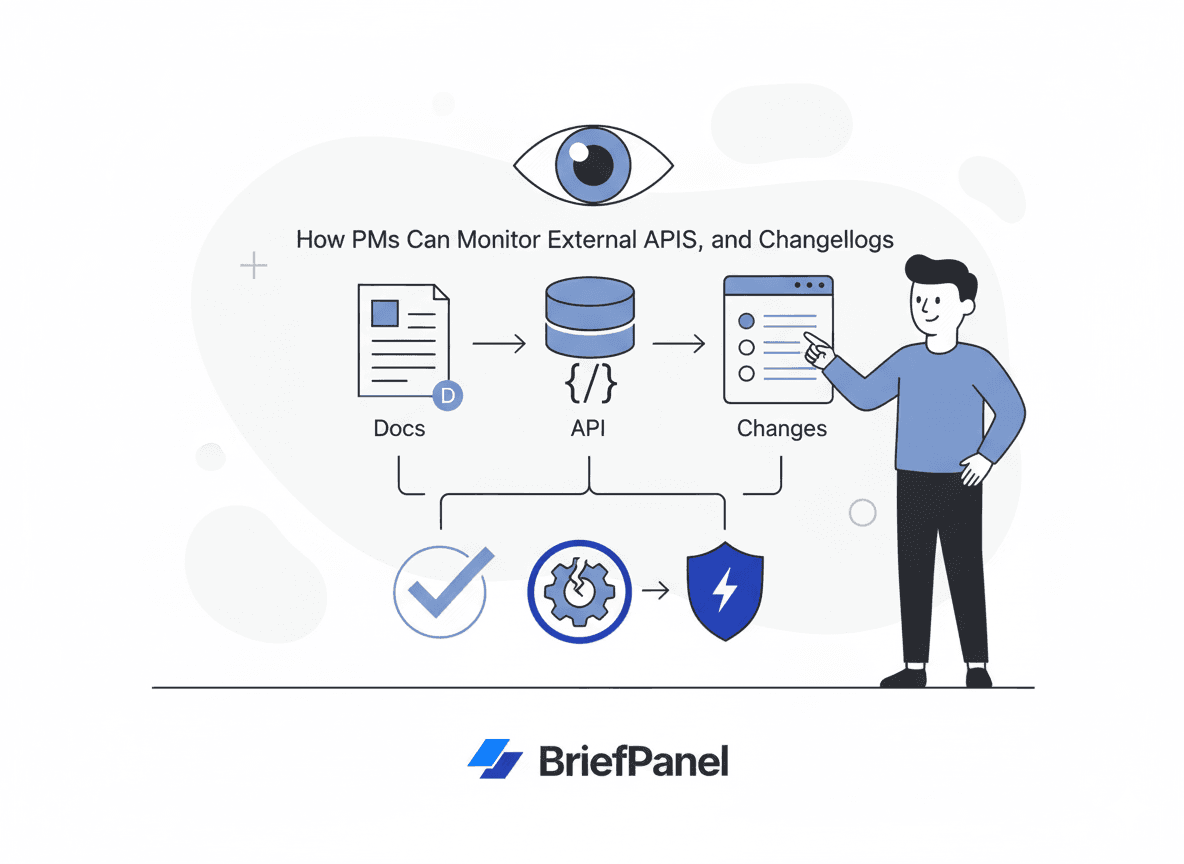
Monitor External Docs, APIs, and Changelogs (and Catch Breaking Changes Early)

Dec 25, 2025

Monitor External Docs, APIs, and Changelogs (and Catch Breaking Changes Early)

A practical workflow to track vendor docs, API references, and changelogs for breaking changes, deprecations, and auth/rate-limit shifts — with real examples and concise briefs your team can act on.

Read more
How to Monitor Procurement, RFP, and Tender Pages (So You Never Miss a Deadline)

Dec 23, 2025

How to Monitor Procurement, RFP, and Tender Pages (So You Never Miss a Deadline)

Track procurement portals, RFP, and tender pages for new postings and silent amendments. Get a proven workflow plus concise AI change briefs with BriefPanel.

Read more

Turn a URL into actionable history

Start with the page that lists what matters. BriefPanel finds the items and builds a history for each one.

Self-service · no required subscription · pay as you go.