Staying current with the literature has quietly become one of the hardest parts of doing research.
Not the experiments. Not the writing. The simple act of knowing what was published this week — across preprint servers, journal tables of contents, conference proceedings, lab pages, and funding portals — now competes for the same hours your team needs for actual science. Miss a relevant preprint and a reviewer flags the overlap. Miss a grant amendment and you submit to last year's criteria.
For R&D and scientific-intelligence teams, research offices, and labs, this is a shared job: someone has to watch the sources, and everyone else has to trust that nothing slipped.
This guide does two things. First, it looks at what the data actually shows about publishing volume and information overload. Then it lays out a practical literature-monitoring framework — organized by source tier and cadence — that a team can run by hand or automate with BriefPanel, which tracks each paper, call and deadline on a public page as its own item and tells you when one is new, modified or removed.
What the data shows: the literature is growing faster than anyone can read it
The "firehose" feeling is not imposter syndrome. It is arithmetic.
- Roughly 3.3 million scholarly articles were published in 2022, climbing past 3.4 million by 2025. Annual output rose from about 2 million papers in 2010 to 3.3 million in 2022 — a jump of roughly 65% in just over a decade (The Conversation, 2024; WordsRated).
- Scientific output has doubled roughly every 10–15 years for over a century, and grown about 8–9% annually since 1980. A widely cited modeling study in Humanities and Social Sciences Communications puts the overall growth rate near 4.1% with a doubling time of about 17 years (Bornmann, Haunschild & Mutz, Nature HSSC, 2021).
- The STM Report — the industry's standard reference — found articles, reviews, and conference papers grew at a roughly 4% compound annual rate from 2014 to 2024, a 53% increase over the decade, with gold open-access articles growing far faster at around 16% CAGR (The STM Report, STM Association / Research Consulting).
Preprints have made the cadence even tighter:
- arXiv set a new monthly record of 24,226 new submissions in October 2024, up from the previous July 2024 high of 21,794, with the steady rate now around 24,000 papers per month. Its cumulative total passed 2.59 million submissions by late 2024, and computer science — machine learning (cs.LG), computer vision (cs.CV), and computational linguistics (cs.CL) — dominates the inflow, accounting for over 6,000 submissions in a single month (arXiv blog, Nov 2024; arXiv monthly submission stats).
- bioRxiv posted 43,629 preprints in 2024 and medRxiv posted 12,863, with bioRxiv now adding roughly 4,000 preprints per month (bioRxiv, Wikipedia summary of server data).
And that is before the journals. Ulrich's directory lists over 48,000 active, peer-reviewed scholarly journals, growing a few percent each year (Enago summary of STM/Ulrich's data). PubMed alone holds more than 40 million citations as of 2025 (PubMed, Wikipedia), and Semantic Scholar indexes over 200 million papers with 2.4 billion citation links (Semantic Scholar, About).
The cost is measured in time. McKinsey's frequently cited estimate is that knowledge workers spend close to 1.8 hours every day — about 9.3 hours a week — searching for and gathering information (Cottrill Research summary of McKinsey). For researchers, that time is squeezed between bench work, teaching, and writing.
There is a downstream risk, too. When nobody can read everything, duplicated effort and missed corrections become structural. Nature's landmark survey of 1,576 researchers found more than 70% had tried and failed to reproduce another scientist's experiment, and "pressure to publish" remains the most-cited cause of the reproducibility crisis (Nature, 2016; "Publish or perish" culture, Nature, 2024). Keeping up with errata, retractions, and revised baselines is not optional housekeeping — it protects your methods section.
The takeaway: the problem is no longer finding papers. Discovery tools are abundant. The problem is detecting what changed and deciding what it means for you, on a sustainable cadence.
The standard toolkit — and where it leaves gaps
Most research teams already run some version of this stack:
Google Scholar alerts and PubMed/NCBI saved searches
Excellent for keyword- and citation-based discovery. But Scholar alerts get noisy for multi-term topics, and neither tool tells you what changed on a page you already track — a revised preprint, an updated protocol, a new eligibility clause on a grant call.
RSS feeds and journal table-of-contents emails
Great for structured journal TOCs. The trouble is centralizing them across arXiv categories, bioRxiv/medRxiv, conference call-for-papers pages, society newsletters, and funder portals — many of which have no clean feed at all.
Discovery and graph tools (Semantic Scholar, Connected Papers, Litmaps)
Brilliant for mapping a citation neighborhood when you start a project. They are pull tools, though: you go to them. They do not watch a specific lab page or funding bulletin and ping you when it moves.
Manual lab Slack posts
They keep teammates aligned — until someone gets busy and the habit breaks.
The shared limitation is collection without curation. You get links, not the context, the diff, or the next step.
A literature-monitoring framework: source tiers and cadence
The fix is to stop treating every source the same way. Sort what your team follows into tiers, then assign each tier a cadence and a monitoring method. This is the framework we recommend.
Tier 1 — Fast-moving preprints (check daily)
This is where a team gets scooped. arXiv categories, bioRxiv/medRxiv collections, ChemRxiv, SSRN — anything in your exact niche.
- Cadence: daily, or every few hours for the one or two categories where speed matters most.
- Method: keyword alerts for discovery, plus change monitoring on the specific category and search pages, and on the abstract pages of the preprints you cite (preprints get revised — v2, v3 — and that matters).
Tier 2 — Journals and proceedings (review weekly)
Journal TOCs, special-issue announcements, and conference proceedings/accepted-papers lists. The signal is high but slower; reading them every day wastes attention.
- Cadence: checked every 24 h.
- Method: RSS where available; page monitoring for special-issue pages and conference sites that lack feeds.
Tier 3 — People, labs, and code (review weekly)
The publication pages of labs you compete or collaborate with, key authors' Google Scholar profiles, and the GitHub repos behind benchmarks, datasets, and libraries you depend on. A new release note or a quietly updated README can change your baselines.
- Cadence: checked every 24 h.
- Method: page monitoring on lab/profile pages; watch or monitor repo release pages.
Tier 4 — Funding, policy, and infrastructure (review weekly)
NIH, NSF, ERC, Wellcome, FAPESP, and similar funder pages; open-data and ethics policy updates; institutional and IRB notices. These change rarely, but each change is high-stakes — a shifted deadline or a new data-sharing clause can decide eligibility.
- Cadence: checked every 24 h.
- Method: change monitoring that names the fields that matter (deadline, eligibility, data-sharing terms), with a lower update sensitivity so formatting churn does not reach you.
The point of the tiers is attention budgeting: spend the most frequent checks on the few sources where speed creates advantage, and check everything else once a day.
Automating the framework with BriefPanel
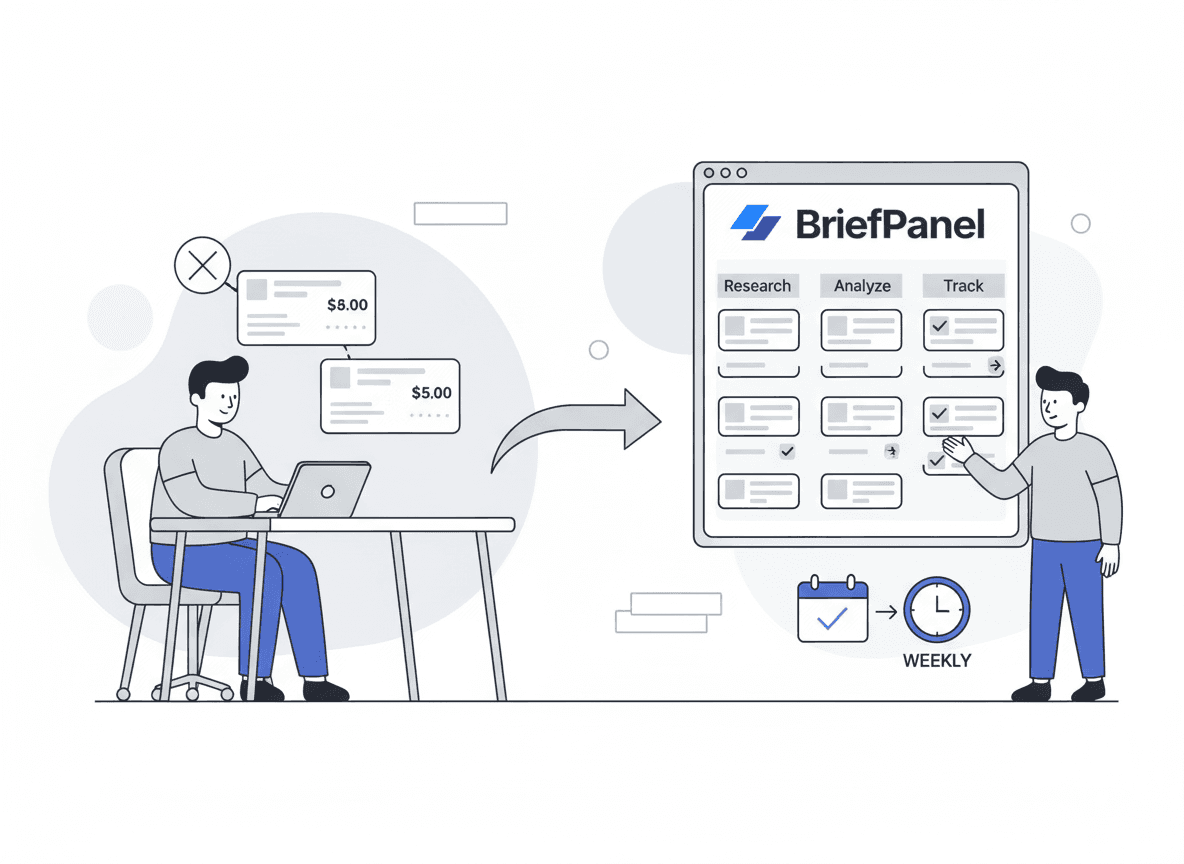
BriefPanel monitors any publicly accessible web page — preprint category pages, journal TOCs, conference sites, lab pages, funder bulletins, GitHub release pages. Each page you add is a source. BriefPanel finds the items on it — each paper, call and deadline — and tracks each one as its own entry, with its own history of new, modified and removed. It fits the tier framework directly:
- Each preprint is an entry, and its fields move. A revised preprint is not a page that "changed somewhere". It is the entry for that paper, with its version field moving from v1 to v2, and both values recorded. The same goes for a new paper on a CFP page or a deadline that moved on a grant call.
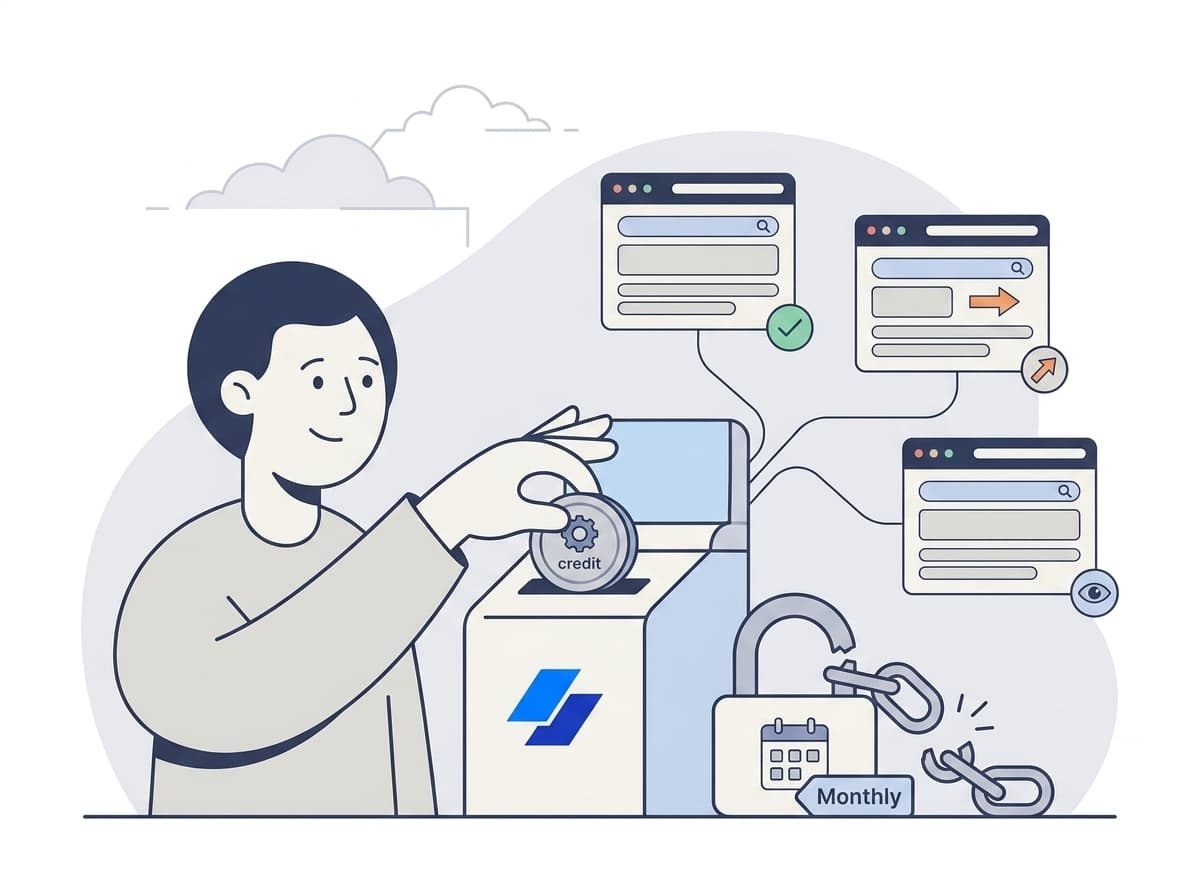
- Abstract pages, not only the listing. When the items on a source have pages of their own, a check can follow them: from an arXiv listing into each paper's abstract page, to read the authors, version and abstract the listing does not show. Each page read costs one credit, up to a fixed ceiling per check, so following item pages costs more than reading the listing alone.
- Long lists. When a listing splits its papers across several pages, a check can read the next pages of the list too.
- Instructions for relevance. Tell each source what to track: "Track each new transformer-efficiency paper and keep the evaluation datasets it names," or "Track each requirement on this grant call; treat a change to data-sharing or human-subjects terms as an update." The fields follow your team's research question, not a generic recap.
- Cadence per source. Each source is checked every 30 min, 1 h, 6 h or 24 h. Put Tier 1 preprint pages on 6 h or 24 h, and the other tiers on 24 h. Checking less often is the main way to spend fewer credits.
- Less noise as you go. On any update, "Don't show updates like this" teaches that source what your team does not care about: matching updates stay in the history but stop notifying you.
- Update sensitivity per source. Set how small a change is worth reporting: lower on a funder page that gets cosmetic edits, higher where one word in an eligibility clause matters.
- Ask the Assistant. Ask things like "Which cs.CL preprints got a new version this month?" or "Which grant deadlines moved this quarter?" It answers from your tracked entries, cites each one, and can draw the trend as a chart.
- Delivery your team already reads. Delivery is set once for the whole account: instant email, a daily or weekly digest, or both, plus push notifications or a Slack or Discord channel through a webhook — written in your team's language. A weekly digest suits a team whose sources mostly move slowly; keep instant email on if Tier 1 needs same-day reads. The REST API, MCP server and signed webhooks feed the same history into your own tools.
- Traceability. Every entry records what happened — the item and its values when it is new, the field that moved with both values when it changes. Cite a precise update in a literature review, a committee report, or a related-work section. Export a source's current items as CSV for a literature table; each update, with its before and after values, stays in the app and is readable through the REST API and MCP server.
Running literature monitoring for a team? See how research teams use BriefPanel →
A 10-minute setup for a research team
- List your sources by tier — Tier 1 preprint category pages, Tier 2 journal TOCs and conference CFPs, Tier 3 lab pages and repos, Tier 4 funder and policy pages.
- Add the public URLs to BriefPanel. Paste them once; no crawler or script needed.
- Write instructions per source so each source's fields answer a real question (see examples below).
- Set the cadence per source following the tier rules — every 6 h or 24 h for Tier 1, every 24 h for the rest.
- Assign an owner to triage each digest, and send the updates to the team's Slack channel through a webhook so the "top 3 takeaways" thread starts from the source.
After the first week your team will have an audit trail of how the field moved — without opening fifteen bookmarks.
Instructions that earn their keep
- "Track each new paper on sequence-modeling architectures under 1B parameters; keep the baselines it compares against."
- "Track each policy requirement on this page; treat a change to human-subjects review or data retention for clinical studies as an update."
- "Track each new benchmark release for tabular ML; keep whether it covers health or finance domains."
- "Track each open call with its deadline and eligibility constraints; keep whether it requires matching funds."
- "Track each preprint with its version, authors and abstract; treat a new version as an update."
Specific instructions keep the tracked fields anchored to your agenda instead of a generic recap.
Traditional approach vs. BriefPanel
| Your need | Traditional approach | BriefPanel advantage |
|---|---|---|
| Track new preprints in a niche | Scholar alerts + manual reading | Each preprint an entry, with authors, version and abstract fields |
| Catch a revised preprint version | Re-reading by chance | The entry's version field moves from v1 to v2, both values kept |
| Monitor benchmark/dataset releases | GitHub watching + RSS | Each release an entry, with the version field and its two values |
| Stay grant-ready | Bookmarking funder pages | Deadlines, eligibility and clauses as fields, in one digest |
| Collaborate asynchronously | Lab chat threads | Updates in the team's Slack channel, linked back to the source |
Frequently asked questions
How do research teams keep up with new papers without burning out? Tier your sources and budget attention. Reserve the most frequent checks for fast-moving preprint pages in your exact niche, and check journals, lab pages, and funders once a day. Pair discovery tools (Google Scholar, PubMed, Semantic Scholar, Connected Papers) for finding papers with change monitoring for detecting what changed on the pages your team already follows.
Can we monitor arXiv, bioRxiv, or a journal's table of contents automatically? Yes. Any publicly accessible page — an arXiv category, a bioRxiv collection, a journal TOC, a conference accepted-papers list — can be monitored. BriefPanel watches the page and tracks each paper and call as its own entry, telling you when one is new, modified or removed — so a v2 preprint or a new CFP entry reaches your team without manual refreshing.
What about grant calls and funding pages? Funder and policy pages change rarely but consequentially. Check them every 24 h, with instructions that name the fields that matter and a lower update sensitivity, so you are alerted on a shifted deadline or a new data-sharing clause — not on formatting edits.
How much does it cost? There is no subscription; you buy credits when you need them. A check spends one credit for every page it reads: the listing, each next page of the list, and each abstract page it follows, up to a fixed ceiling per check. A source's settings show what one of its checks costs, and the pricing calculator shows current prices.
Does BriefPanel replace Google Scholar or PubMed? No — it complements them. Scholar and PubMed are strong at discovery and citation alerts. BriefPanel adds the missing layer: watching specific pages your team cares about and recording which field changed, and from what to what.
Can a distributed R&D team share it? Yes. Updates can go out by email, digest, push, or a Slack or Discord webhook, written in your team's language, so teams across sites stay aligned on the same sources. Items can also leave the app as CSV, or through the REST API and MCP server.
Get your first tracked item today
Teams that automate monitoring finish drafts faster, avoid duplicated work, and spot collaboration chances sooner. With output growing several percent a year and preprint servers setting fresh records, the edge goes to teams that detect change early — not those who read everything.
BriefPanel turns scattered alerts into actionable, citation-ready updates, delivered where your team already works.
See BriefPanel for research teams → Begin with free credits and scale up as you add coverage.
Related guides
Sources
- The Conversation — Scientists report millions of new discoveries every year (2024)
- WordsRated — Number of Academic Papers Published per Year
- Bornmann, Haunschild & Mutz — Growth rates of modern science, Nature Humanities and Social Sciences Communications (2021)
- STM Association / Research Consulting — The STM Report: an overview of scientific and scholarly publishing
- arXiv blog — arXiv sets new record for monthly submissions (again), Nov 2024
- arXiv — Monthly submission statistics
- bioRxiv — Server data overview (Wikipedia)
- PubMed — Database overview (Wikipedia)
- Semantic Scholar — About / corpus size
- Enago — 2021 STM Report summary, including active-journal counts
- Cottrill Research — Summary of McKinsey time-spent-searching data
- Nature — 1,500 scientists lift the lid on reproducibility (2016)
- Nature — "Publish or perish" culture blamed for reproducibility crisis (2024)