
Competitors rarely announce a repositioning.
They change their homepage headline. They swap a target persona. They add “AI” to the hero. They change the CTA from “Start free trial” to “Book a demo.”
If you’re only doing competitive review once a quarter, you’ll miss the subtle shifts that drive pipeline.
This guide shows how to monitor competitor homepage messaging reliably—and how to turn noisy page diffs into short, shareable briefs with BriefPanel.
What to monitor on competitor websites
The homepage is a strategy document in disguise. Track:
- hero headline and subheadline
- primary CTA copy and placement
- key benefit bullets
- positioning language (SMB vs enterprise)
- new proof points (logos, metrics)
- pricing mention changes (“from $X”, “request pricing”)
- product screenshots and feature callouts
Small copy edits often signal big moves.
The main approaches
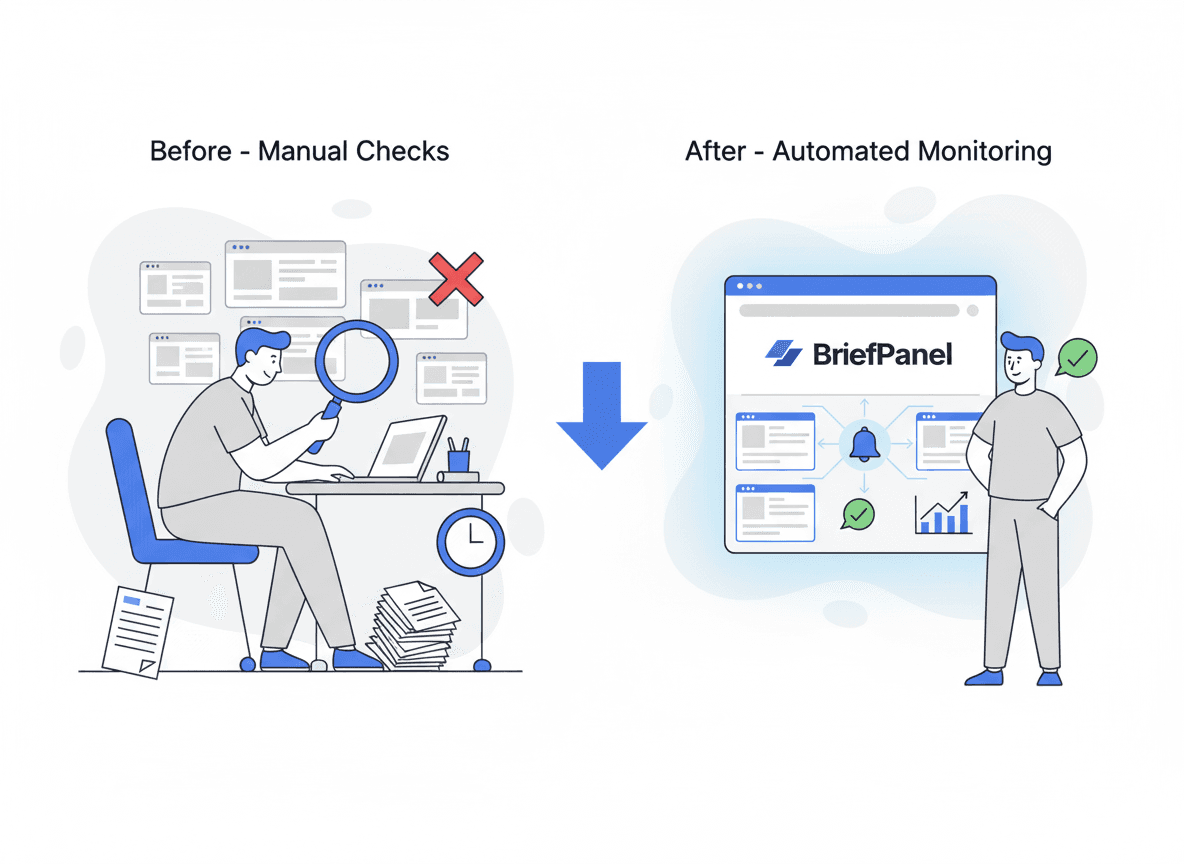
1) Manual checks
Works occasionally. Fails as a system.
You’ll forget what changed, and you’ll miss edits that happen between reviews.
2) Screenshot archives
Better than nothing, but difficult to search and summarize.
3) Visual monitoring tools
Helpful for UI diffs, but can be noisy and still requires interpretation.
4) Website change monitoring (best for URL-level tracking)
Monitoring the exact homepage URL is the most reliable way to catch changes.
The remaining problem: making the update easy to understand and share.
The workflow upgrade: monitoring + AI briefs
BriefPanel monitors competitor pages and produces AI-written briefs so you can:
- see what changed
- understand the positioning implication
- share a clean update with sales/marketing/product
Want competitive updates in 2 minutes a day? Try BriefPanel free →
Prompt template: competitor messaging
Use a prompt like this:
"Summarize only meaningful messaging changes: target audience, positioning claims, CTAs, pricing mentions, key features/benefits, and proof points (logos, metrics). Ignore navigation/footer and minor formatting changes."
10-minute setup
- Add competitor homepages (and 2–4 key landing pages).
- Set cadence:
- daily for fast-moving competitors
- weekly for stable markets
- Add the messaging prompt.
- Review the digest and update battlecards.
Start catching positioning shifts early
Your competitors are changing their story every week.
Set up monitoring once and get a clear brief when the narrative changes.